The State of the adult social care sector and workforce in England is Skills for Care’s yearly analysis of the care workforce, published each October. It draws on the Adult Social Care Workforce Data Set (ASC-WDS), which holds records for more than 750,000 staff across over 21,000 care locations, and estimates the size, pay, turnover and make-up of the whole sector.
Skills for Care is the government-backed workforce development body for adult social care in England. Its figures are widely used by the Department of Health and Social Care, councils and providers when planning services.
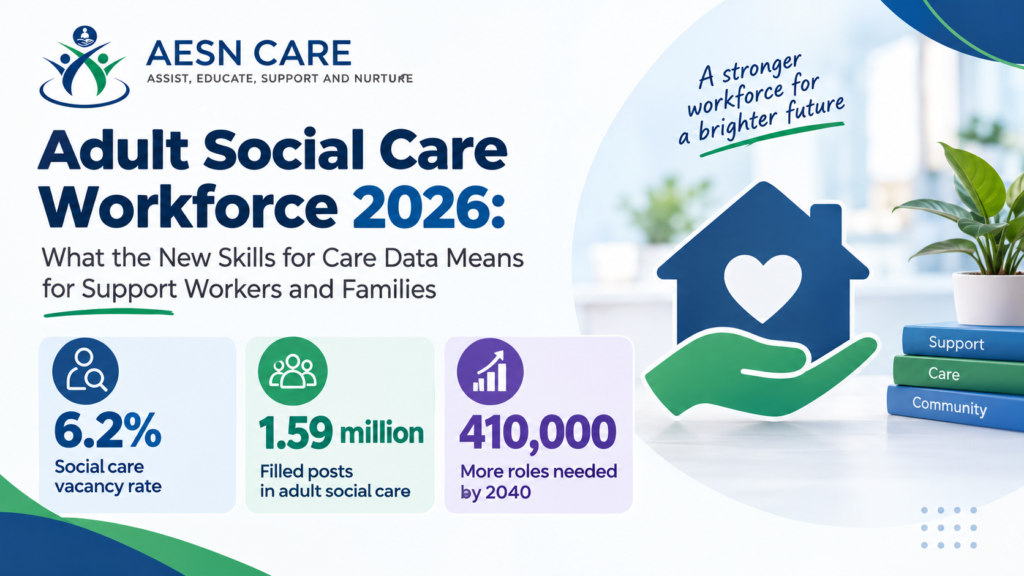
Adult social care workforce 2026: the headline figures
These are the national figures for 2025/26 from the 2026 report and Skills for Care’s June 2026 release.
| Measure (England, 2025/26) | Figure |
|---|---|
| Total posts | 1.69 million |
| Filled posts | 1.59 million (up 22,000, or 1.4%) |
| People working in adult social care | 1.46 million |
| Vacant posts on an average day | around 96,000 (down 10.5%) |
| Vacancy rate | 6.2% (7.0% in 2024/25) |
| Care and support worker filled posts | 925,000 |
| Care and support worker turnover | 26.9% (about 221,000 leavers) |
| Registered manager vacancy rate | 10.2% |
| Filled posts in services for adults with a learning disability and/or autism | 194,000 |
| Extra posts needed by 2040 | 410,000 |
Three points stand out.
- Vacancies are at a 10-year low. At 6.2%, the vacancy rate is the lowest since 2015/16, down from a peak of around 150,000 vacancies in 2021/22. It is still about three times the rate in the wider economy.
- Growth has slowed. Filled posts grew 1.4%, the slowest rate in four years.
- The domestic workforce is shrinking. Posts filled by British nationals fell by 40,000 in a year and by 130,000 since 2020/21.
Why is international recruitment falling?
New international recruits arriving directly from abroad fell to around 30,000 in 2025/26, the lowest level in four years. The main reason is policy: the Care Worker visa route closed to new overseas applicants on 22 July 2025.
People already in the UK on other visas can still extend or switch into care worker and senior care worker roles during a transition period that runs until 22 July 2028, which the government says it will keep under review.
For the sector, this means future growth depends much more on recruiting and keeping people who already live in the UK. That is why pay, contracts and training are now under the spotlight.
Care worker pay in 2026
Skills for Care’s pay report put the median hourly rate for independent-sector care workers at £12.60 in December 2025. That was 39p above the National Living Wage at the time (£12.21).
Since 1 April 2026, the National Living Wage for workers aged 21 and over has been £12.71 an hour, so employers have had to raise pay again. Skills for Care says its March 2026 pay figures will follow in its next pay report.
Other pay findings from the December 2025 data:
- Care workers with five or more years’ experience earned on average just 10p an hour more than those new to the sector.
- Senior care workers had a median of £13.33, about 6% more than care workers.
- A newly appointed NHS healthcare assistant on Band 3 earned 15p an hour more than the care worker median, rising to £1.00 more after two years.
- Care worker pay was 1p below the median for sales and retail assistants.
For domiciliary care services, which in Skills for Care’s definition include supported living and extra care, mean care worker pay in the independent sector was £12.96 an hour in 2025/26.
We have not quoted a single “average salary” for support workers because annual earnings depend heavily on hours, shift patterns and sleep-in arrangements. The legal floor is the clearest benchmark: £12.71 an hour for anyone aged 21 or over.
Zero-hours contracts and working patterns
How people are employed matters as much as hourly pay. In 2025/26:
- 21% of all filled posts in adult social care were on zero-hours contracts (around 325,000).
- In domiciliary care the figure was 34%, rising to 44% of care workers in those services.
- 58% of the workforce worked full time and 88% were on permanent contracts.
The report also notes that care workers on zero-hours contracts are more likely to leave. Media coverage of the report highlighted Skills for Care’s finding that care worker turnover fell from 34.3% to 15.3% where employers combined competitive pay, guaranteed hours, training, qualifications and full-time work.
Turnover: who leaves, and why it matters
Care and support worker turnover was 26.9% in 2025/26. In domiciliary care, which includes supported living, overall turnover was 23.5%, and 28.6% for care workers.
Younger staff are the most likely to move on. Coverage of the report put turnover among under-25s at 35.5%, the highest of any age group, while under-25s make up only about 7% of the care workforce.
Leadership also makes a difference. The same coverage reported that care worker turnover fell from 28.3% to 20.6% as registered managers became more experienced. With the registered manager vacancy rate at 10.2% and around 31% of registered managers aged 55 or over, stable leadership is a growing pressure point.
Why turnover matters to families
Every time a support worker leaves, the person they support has to build trust with someone new. For adults with a learning disability, autism or complex needs, a change of staff can affect routines, communication and wellbeing. Low turnover is one of the clearest signs of a well-run service.
Skills and responsibilities are growing
The 2026 report shows care workers are taking on more health-related tasks.
- Delegated healthcare activities: in 59% of CQC-regulated services that reported doing them, non-nursing staff carried out delegated healthcare activities. These are tasks such as some medication routes or health monitoring, delegated by a healthcare professional.
- Qualifications: in domiciliary care, 44% of staff held a relevant social care qualification, and 35% of direct care workers were qualified at Level 2 or above.
- Care Certificate: in domiciliary care, 44% of staff had completed it, 14% were part-way through and 42% had not started.
- Care Workforce Pathway: 26% of independent-sector employers who answered said they use the pathway, while 44% did not know about it.
The Care Workforce Pathway sets out the skills, knowledge and behaviours expected at each level of a care career. Alongside mandatory Oliver McGowan training on learning disability and autism, it gives support workers a clearer route to develop and be recognised.
What does the 2026 report mean for support workers?
For people working in care, or thinking about it, the data points to a few practical conclusions.
- Demand is not going away. The sector is projected to need 410,000 more posts by 2040, and with overseas recruitment closed, UK-based workers are in demand.
- Conditions differ widely between employers. Zero-hours use, guaranteed hours, paid training and sick pay vary a lot. The report found only 24% of independent-sector employers who responded paid above Statutory Sick Pay.
- Experience is poorly rewarded in pay alone. A 10p experience premium means progression usually comes from moving into senior, specialist or leadership roles.
- Training is a real advantage. Completing the Care Certificate, a Level 2 or 3 qualification and specialist training makes you more confident and more employable.
- Pay reform is coming, slowly. Under the Employment Rights Act 2025, the government is setting up an Adult Social Care Negotiating Body. Negotiations are expected to start around April 2027, with the first Fair Pay Agreement due to take effect in April 2028.
When comparing jobs, ask each employer about guaranteed hours, paid training time, sick pay, travel time, sleep-in pay and how often rotas change. These conditions affect your income and wellbeing as much as the hourly rate.
What does it mean for families choosing support?
Falling vacancies are good news, but the national figure hides big differences between providers. When you are choosing supported living or home care for a relative, workforce questions are some of the most useful you can ask.
| Question to ask a provider | Why it matters |
|---|---|
| How long have the staff in this team worked here? | Shows continuity and stability |
| How do you match support workers to the person? | Shared interests and communication styles build trust |
| Are staff on guaranteed hours or zero-hours contracts? | Linked to retention in the Skills for Care data |
| What training do staff complete beyond the Care Certificate? | Shows skills for autism, learning disability or complex needs |
| Has every worker completed Oliver McGowan training? | CQC-registered providers must train staff in learning disability and autism, and this is the government’s preferred training |
| How long has the registered manager been in post? | Manager experience is linked to lower turnover |
| How do you cover sickness and holidays? | Reveals reliance on agency staff |
A good provider will answer these openly. You can also read the provider’s latest CQC report, which looks at whether services have enough suitably qualified, competent and experienced staff.
Key takeaways
- Adult social care in England had 1.59 million filled posts and a 6.2% vacancy rate in 2025/26, the lowest vacancy rate in a decade.
- Growth slowed to 1.4% as British workers fell by 40,000 and new recruits from abroad dropped to around 30,000.
- Care worker median pay was £12.60 in December 2025; the legal minimum for over-21s is now £12.71.
- Zero-hours contracts remain common in domiciliary care, and they are linked to higher turnover.
- The first Fair Pay Agreement for care workers is due in April 2028.
- For families, staff stability, training and management experience are the questions to ask.
How AESN Care approaches its workforce
At AESN Care, we provide supported living and domiciliary care for adults with learning disabilities, autism, mental health needs, physical disabilities, dementia and complex needs. The national data reinforces what we see every day: people get the best support from consistent teams who know them well, and support workers stay when they feel trained, valued and part of a team.
If you are a family member or commissioner, use the questions above when you speak to any provider, including us. You can contact our team to ask how we recruit, train and match staff for the person you support.
If you are a support worker or thinking of joining care, read our guide on how to become a support worker in the UK, then see our current care careers.
Frequently asked questions
What is the adult social care vacancy rate in 2026?
Skills for Care’s latest data puts the adult social care vacancy rate in England at 6.2% for 2025/26, equal to around 96,000 vacant posts on an average day. This is the lowest rate since 2015/16, but still around three times the vacancy rate in the wider economy.
How many people work in adult social care in England?
An estimated 1.46 million people worked in adult social care in England in 2025/26, filling 1.59 million posts. Some people hold more than one job. Care and support workers make up the largest group, with about 925,000 filled posts.
What is the average pay for a care worker in 2026?
The median hourly pay for independent-sector care workers was £12.60 in December 2025, according to Skills for Care. Since April 2026 the National Living Wage for workers aged 21 and over has been £12.71, so this is the legal minimum. Updated March 2026 pay data is due in Skills for Care’s next pay report.
Why are fewer international care workers coming to the UK?
The Care Worker visa route closed to new overseas applicants on 22 July 2025. People already in the UK can still switch or extend into care roles until 22 July 2028. New international recruits arriving from abroad fell to around 30,000 in 2025/26, the lowest in four years.
What is the staff turnover rate in social care?
Turnover for care and support workers was 26.9% in 2025/26, equal to about 221,000 leavers. In domiciliary care services, which include supported living, turnover was 23.5% overall and 28.6% for care workers.
When will the Fair Pay Agreement for care workers start?
The government expects the Adult Social Care Negotiating Body to begin negotiations around April 2027, with the first Fair Pay Agreement taking effect in April 2028. It has set up to £500 million for councils in the first year.
How can families check if a care provider has a stable workforce?
Ask how long staff have been in the team, whether they are on guaranteed hours, what training they complete and how long the registered manager has been in post. Read the provider’s latest CQC inspection report as well.
Adult Social Care Workforce 2026: What the New Skills for Care Data Means for Support Workers and Families
The State of the adult social care sector and workforce in England is Skills for Care’s yearly analysis of the care workforce, published each October. It draws on the Adult Social Care Workforce Data Set (ASC-WDS), which holds records for more than 750,000 staff across over 21,000 care locations, and estimates the size, pay, turnover and make-up of the whole sector. Skills for Care is the government-backed workforce development body for adult social care in England. Its figures are widely used by the Department of Health and Social Care, councils and providers when planning services. Adult social care workforce 2026: the headline figures These are the national figures for 2025/26 from the 2026 report and Skills for Care’s June 2026 release. Measure (England, 2025/26) Figure Total posts 1.69 million Filled posts 1.59 million (up 22,000, or 1.4%) People working in adult social care 1.46 million Vacant posts on an average day around 96,000 (down 10.5%) Vacancy rate 6.2% (7.0% in 2024/25) Care and support worker filled posts 925,000 Care and support worker turnover 26.9% (about 221,000 leavers) Registered manager vacancy rate 10.2% Filled posts in services for adults with a learning disability and/or autism 194,000 Extra posts needed by 2040 410,000 Three points stand out. Vacancies are at a 10-year low. At 6.2%, the vacancy rate is the lowest since 2015/16, down from a peak of around 150,000 vacancies in 2021/22. It is still about three times the rate in the wider economy. Growth has slowed. Filled posts grew 1.4%, the slowest rate in four years. The domestic workforce is shrinking. Posts filled by British nationals fell by 40,000 in a year and by 130,000 since 2020/21. Why is international recruitment falling? New international recruits arriving directly from abroad fell to around 30,000 in 2025/26, the lowest level in four years. The main reason is policy: the Care Worker visa route closed to new overseas applicants on 22 July 2025. People already in the UK on other visas can still extend or switch into care worker and senior care worker roles during a transition period that runs until 22 July 2028, which the government says it will keep under review. For the sector, this means future growth depends much more on recruiting and keeping people who already live in the UK. That is why pay, contracts and training are now under the spotlight. Care worker pay in 2026 Skills for Care’s pay report put the median hourly rate for independent-sector care workers at £12.60 in December 2025. That was 39p above the National Living Wage at the time (£12.21). Since 1 April 2026, the National Living Wage for workers aged 21 and over has been £12.71 an hour, so employers have had to raise pay again. Skills for Care says its March 2026 pay figures will follow in its next pay report. Other pay findings from the December 2025 data: Care workers with five or more years’ experience earned on average just 10p an hour more than those new to the sector. Senior care workers had a median of £13.33, about 6% more than care workers. A newly appointed NHS healthcare assistant on Band 3 earned 15p an hour more than the care worker median, rising to £1.00 more after two years. Care worker pay was 1p below the median for sales and retail assistants. For domiciliary care services, which in Skills for Care’s definition include supported living and extra care, mean care worker pay in the independent sector was £12.96 an hour in 2025/26. We have not quoted a single “average salary” for support workers because annual earnings depend heavily on hours, shift patterns and sleep-in arrangements. The legal floor is the clearest benchmark: £12.71 an hour for anyone aged 21 or over. Zero-hours contracts and working patterns How people are employed matters as much as hourly pay. In 2025/26: 21% of all filled posts in adult social care were on zero-hours contracts (around 325,000). In domiciliary care the figure was 34%, rising to 44% of care workers in those services. 58% of the workforce worked full time and 88% were on permanent contracts. The report also notes that care workers on zero-hours contracts are more likely to leave. Media coverage of the report highlighted Skills for Care’s finding that care worker turnover fell from 34.3% to 15.3% where employers combined competitive pay, guaranteed hours, training, qualifications and full-time work. Turnover: who leaves, and why it matters Care and support worker turnover was 26.9% in 2025/26. In domiciliary care, which includes supported living, overall turnover was 23.5%, and 28.6% for care workers. Younger staff are the most likely to move on. Coverage of the report put turnover among under-25s at 35.5%, the highest of any age group, while under-25s make up only about 7% of the care workforce. Leadership also makes a difference. The same coverage reported that care worker turnover fell from 28.3% to 20.6% as registered managers became more experienced. With the registered manager vacancy rate at 10.2% and around 31% of registered managers aged 55 or over, stable leadership is a growing pressure point. Why turnover matters to families Every time a support worker leaves, the person they support has to build trust with someone new. For adults with a learning disability, autism or complex needs, a change of staff can affect routines, communication and wellbeing. Low turnover is one of the clearest signs of a well-run service. Skills and responsibilities are growing The 2026 report shows care workers are taking on more health-related tasks. Delegated healthcare activities: in 59% of CQC-regulated services that reported doing them, non-nursing staff carried out delegated healthcare activities. These are tasks such as some medication routes or health monitoring, delegated by a healthcare professional. Qualifications: in domiciliary care, 44% of staff held a relevant social care qualification, and 35% of direct care workers were qualified at Level 2 or above. Care Certificate: in domiciliary care, 44% of staff had completed it, 14% were part-way through and 42% had not
Oliver McGowan Training Explained: What Families and Support Workers Should Know
If someone you love has a learning disability or is autistic, you want the people supporting them to understand what that means day to day. If you are starting out as a support worker, you want to know what training to expect. The Oliver McGowan Mandatory Training on Learning Disability and Autism sits at the centre of both questions. This guide explains what the training is, who must complete it, how Tier 1 and Tier 2 differ, how often it is refreshed, and what the September 2025 code of practice changed. What is Oliver McGowan training? Oliver McGowan training is the government’s preferred and recommended training on learning disability and autism for health and social care staff in England. It is co-delivered by people with a learning disability and autistic people, and it comes in two tiers: Tier 1 for general awareness and Tier 2 for staff who provide care and support directly. The training is designed to meet the standards in the Core Capabilities Frameworks for learning disability and autism, published by Skills for Health. Its aim is practical: helping staff understand people’s needs, make reasonable adjustments and avoid the mistakes that lead to poor or unsafe care. Who was Oliver McGowan? Oliver McGowan was a young autistic man with a mild learning disability and epilepsy. He died at Southmead Hospital, Bristol, on 11 November 2016, aged 18. His inquest heard that he had been given the antipsychotic medication olanzapine, despite his parents’ clear instructions that he should not receive it, and that it led to neuroleptic malignant syndrome. His mother, Paula McGowan, led a campaign arguing that better staff understanding of learning disability and autism could prevent avoidable harm. The training that now carries Oliver’s name is the result. Is Oliver McGowan training mandatory? Yes, in practice, for CQC-registered services. Since 1 July 2022, the Health and Care Act 2022 has required every CQC-registered health and adult social care provider in England to make sure its staff receive learning disability and autism training appropriate to their role. The Oliver McGowan programme is the government’s preferred way to meet that duty. The law requires appropriate training; the code of practice sets out what “appropriate” means. A provider can use a different package, but it must meet the same standards, including co-delivery by people with lived experience. CQC takes the code into account when it assesses services. The Oliver McGowan code of practice (2025) After a public consultation in 2023 and a government response in June 2025, the Oliver McGowan code of practice on statutory learning disability and autism training was laid before Parliament for 40 days. It became final on 6 September 2025, and DHSC published it on GOV.UK, with an easy-read version, on 18 September 2025. The code uses two kinds of wording that matter to families and staff: “Must” – a requirement, such as covering the minimum curriculum, co-delivery by experts with lived experience and refreshing training at least every three years. “Should” – good practice, such as checking skills after training and picking up learning in supervision. The code applies to all staff of CQC-registered providers, not only people in hands-on roles. Receptionists, schedulers, managers and drivers all need training at the level that fits their contact with the people a service supports. Tier 1 vs Tier 2: what’s the difference? Tier 1 is for staff who need a general awareness of the support autistic people and people with a learning disability may need. Tier 2 is for staff who provide care or support directly, or who may need to make decisions about someone’s care. Both tiers start with the same e-learning. Tier 1 Tier 2 Who it’s for Staff who need general awareness (for example office, admin or occasional-contact roles) Staff giving direct care and support, including most support workers and team leaders Part 1 90-minute e-learning with handbook The same 90-minute e-learning with handbook Part 2 1-hour live online interactive session 1-day face-to-face session Co-delivered by At least one person with a learning disability and one autistic person At least one person with a learning disability and one autistic person Typical content What learning disability and autism are; reasonable adjustments; reflecting on attitudes All of Tier 1, plus areas such as diagnostic overshadowing, related health conditions, the Mental Capacity Act and Equality Act, STOMP/STAMP, Ask Listen Do and LeDeR learning Staff who need Tier 2 can go straight to Tier 2; they do not have to finish the Tier 1 interactive session first. What does Tier 2 cover that matters in supported living? Several Tier 2 themes come up every week in supported living and home care: Diagnostic overshadowing – assuming a change in behaviour is “part of their learning disability” when it may be pain, illness or distress. STOMP and STAMP – national programmes to stop the over-medication of people with a learning disability or autistic people, and to support access to appropriate medicine. Mental capacity – supporting people to make their own decisions, and following the Mental Capacity Act when they cannot. Reasonable adjustments – changing how support or communication is offered so it works for the person. Ask Listen Do – an NHS England initiative to make it easier for people and families to give feedback, raise concerns and complain. If you want to read more on these themes, our guide to understanding learning disabilities covers them from a family point of view. How often does Oliver McGowan training need to be refreshed? The code says training must be refreshed at least every three years. A provider should refresh it sooner if someone’s role changes, if supervision shows a gap in knowledge, or if the service starts supporting people with different needs. Refreshers should again follow the code’s standards, including co-delivery. What does it mean for families? For families, the training is a useful benchmark. It gives you a shared language with a provider and some concrete questions to ask before or during a placement. Training alone doesn’t guarantee
How to Become a Support Worker in the UK: A Practical 2026 Guide
Support work is one of the few careers in the UK where you can start without formal qualifications, train while you earn and build towards a recognised professional pathway. It is also a job where the right person makes a visible difference: helping someone cook their own meal, catch a bus on their own, or get through a difficult day calmly. This guide is for anyone thinking about how to become a support worker in UK, especially in learning disability, autism and supported living services. It explains what the role involves, what employers check before you start, the training you’ll receive, what you can expect to earn, and how 2026 changes affect people starting out now. What is a support worker? A support worker helps people with care and support needs to live as independently as possible. In adult social care, that usually means supporting adults with learning disabilities, autism, mental health needs, physical disabilities or complex conditions with daily living, personal care, health appointments, money, relationships and community activities. Support follows each person’s own care and support plan. Support workers are sometimes confused with care workers. The skills overlap, but there is a difference in emphasis: Care worker (typical) Support worker (typical) Main focus Meeting personal care needs Building skills and independence Common settings Care homes, home care visits Supported living, community services, home care Typical day Scheduled tasks and visits Activities planned around the person’s goals Who you support Often older adults Often working-age adults with learning disabilities, autism or mental health needs In practice many job titles are used interchangeably, so read the job description rather than relying on the title. What does a support worker do day to day? No two shifts look the same, because the work follows the person rather than a fixed routine. In a supported living service, a typical week might include: Daily living: shopping, cooking, cleaning and budgeting, doing things with the person rather than for them Personal care: washing, dressing and toileting where the support plan includes it, always with dignity and consent Health: prompting or administering medication (after training), attending GP and hospital appointments, noticing changes in wellbeing Community life: college, work placements, clubs, faith groups, seeing family and friends Emotional support: helping someone manage anxiety, change or behaviours that challenge using agreed, positive strategies Recording: writing clear daily notes and reporting safeguarding concerns If you support autistic people or people with learning disabilities, small details matter a lot: a consistent routine, communicating in the way someone prefers, or knowing what helps them feel safe. Can you become a support worker with no experience? Yes. Most providers recruit for values first and train for skills. You do not need a degree or a care qualification to apply for an entry-level support worker role. Employers will look for: Reliability and honesty Patience, kindness and respect for people’s choices Good basic communication in English (spoken and written, because you’ll keep records) Willingness to learn and follow care plans Flexibility. Supported living often runs 24/7, so many roles include early, late, weekend or sleep-in shifts A full driving licence is useful for some services but not always essential Life experience counts too. Caring for a family member, volunteering, customer service, hospitality and retail all build skills that transfer directly into support work. On your application, describe how you treated people, not just what tasks you did. How to become a support worker in UK: step by step Step 1: Check you meet the basic requirements To work in adult social care in England you must: Be 18 or over (most providers set this minimum for roles involving personal care) Have the right to work in the UK. You can prove this with a British or Irish passport, or with a share code or eligible immigration document. See GOV.UK’s guide to proving your right to work. Pass pre-employment checks, including references and a DBS check (see Step 3) A note for overseas applicants: the Care Worker visa route closed to new applications from outside the UK on 22 July 2025. Limited transitional arrangements for people already in the UK run until 22 July 2028 (Pinsent Masons summary of the rule change). Always check current rules on GOV.UK. This article is general information, not immigration advice. Step 2: Apply to a provider that trains new starters Look for employers that offer a paid induction and shadow shifts, and that offer specialist training for the people they support. Ask at interview: How long is the induction and how many shadow shifts will I do? Which qualifications will you support me to take? What specialist training do you provide in learning disability and autism? How are rotas planned, and how much notice do I get? Expect a values-based interview. You may be asked scenario questions such as “What would you do if someone refused their medication?” or “How would you support someone to make a choice you disagreed with?” There’s no trick answer. Employers want to see that you put the person first, follow the support plan and know when to ask for help. Step 3: Complete your enhanced DBS check Because support workers usually provide personal care or help with health and finances, most roles need an enhanced DBS check with a check of the adults’ barred list. According to GOV.UK eligibility guidance, this covers roles such as physically helping adults with eating, drinking, toileting or washing, and helping with day-to-day finances. Your employer applies for the check, not you. A criminal record does not automatically rule you out of care work. Employers must assess convictions fairly and in relation to the role, and Skills for Care publishes guidance on DBS checks for adult social care roles. Step 4: Complete your induction and the Care Certificate New starters complete an induction based on the Care Certificate standards, the agreed baseline of knowledge for new care workers in England. These cover areas such as duty of care, privacy and dignity, safeguarding adults, communication, health and
How Much Does Supported Living Cost in England in 2026? A Guide for Families
How Much Does Supported Living Cost in England in 2026? A Guide for Families The cost of supported living for an adult with a learning disability, autism, or complex care needs is one of the most frequently misunderstood aspects of adult social care funding — and one of the most consequential. Families who do not understand the funding structure may be surprised to find that costs significantly exceed what they expected, or that funding they thought would cover everything does not. This guide explains exactly how supported living is costed and funded in England in 2026, what families can expect to pay, and what the available funding sources are. Why Supported Living Costs Are Complex Unlike a care home, where a single weekly or monthly fee typically covers accommodation and care together, supported living has a split-cost structure. The housing component and the care and support component are always charged, contracted, and (in most cases) funded separately. This is by design — it is what gives the tenant legal security — but it means there are two distinct funding conversations to have. Component 1: The Housing Cost The housing cost covers rent, service charges, and building maintenance. In supported living arrangements, the individual holds a tenancy with a housing provider (often a Housing Association or a private landlord with appropriate accommodation). The rent is charged at market rates for the area, adjusted where applicable under Local Housing Allowance rules. Housing costs in supported living are typically funded through Housing Benefit (now paid as part of Universal Credit for working-age adults) rather than through the local authority care budget. For most adults with learning disabilities or autism who have low income, Housing Benefit can cover or significantly offset the rent. The means test for Housing Benefit is separate from the care funding means test. Component 2: The Care and Support Cost The care and support cost covers the staffing, management, and coordination of the personal support provided to the individual in their home — the support workers who assist with daily living, medication, community access, and safety. This is what most people think of as the ‘care’ element. Care and support costs in supported living vary enormously based on the level of need. The primary driver is the number of staffing hours commissioned per week, and the staffing ratio required (one-to-one, two-to-one, or shared staff across multiple tenants). Support Intensity Typical Weekly Hours Typical Annual Cost (care component only) Low support (shared staff, community focus) 10–20 hours/week £18,000–£35,000/year Medium support (significant daily assistance) 25–40 hours/week £35,000–£60,000/year High support (frequent 1:1, complex needs) 40–80 hours/week £60,000–£100,000+/year Very high / waking nights + specialist 80–168 hours/week £100,000–£200,000+/year These are approximate figures. Actual commissioning rates depend on the local authority’s framework agreements, the provider’s cost base, and the complexity of the individual’s needs. Specialist placements for individuals with dual diagnosis, behaviours that challenge, or forensic histories cost significantly more than the figures above. Who Pays — Local Authority, NHS, or Family? Local Authority Funded If the individual has eligible care and support needs under the Care Act 2014 and does not have capital assets above £23,250, the local authority funds the care component subject to a financial assessment. The local authority agrees a personal budget and either manages the provision directly, issues a direct payment, or commissions a provider. NHS Continuing Healthcare (CHC) Where an individual’s primary need is health-based (rather than social care), NHS Continuing Healthcare funding covers the full cost of care including accommodation — with no means test. CHC eligibility is assessed by the Integrated Care Board and is decided on clinical grounds. It is frequently refused at initial assessment and frequently overturned on appeal. Self-Funding Individuals with capital above £23,250 are expected to self-fund their care until their assets deplete to the lower threshold. For supported living, the means test applies to the care and support component only — not the housing cost, which is assessed separately through the benefits system. Deferred Payment Agreements Where a person owns property, local authorities may offer a Deferred Payment Agreement, allowing care costs to be secured against the property and paid from the estate — preventing a forced sale during the person’s lifetime. The ‘Personal Budget’ and What It Covers When the local authority funds care, it sets a ‘personal budget’ — the amount it calculates is needed to meet the individual’s eligible needs. This budget funds the care and support component. It does not cover housing costs, personal spending, or additional activities beyond those specified in the care plan. The personal budget can be taken as a managed service (the LA commissions a provider) or as a direct payment (the individual or a nominated person manages the funding and pays their own provider). AESN Care works with both local authority commissioned placements and direct payment arrangements. Speak to AESN Care AESN Care provides supported living and outreach services across England. We work with local authority commissioners, NHS teams, and self-funding families to design and deliver support that meets individual needs within available funding. Contact us to discuss costs and options for your family.
What Is an EHC Plan and What Happens to It When Your Child Turns 18?
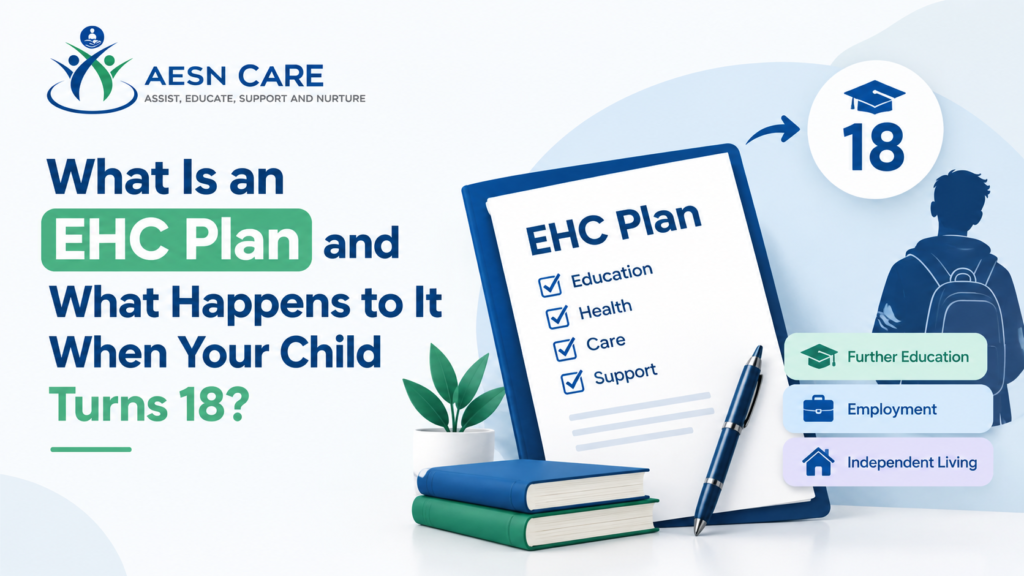
What Is an EHC Plan and What Happens to It When Your Child Turns 18? If your child has a Special Educational Need or Disability and holds an Education, Health and Care (EHC) Plan, the plan has been the central document governing their support from childhood through their school years. It has funded their teaching assistant, their therapy input, their specialist school placement, and the coordination between education, health, and care services. Then, at some point before or around their 18th birthday — and potentially up to age 25 if they remain in education — the world changes. The Children and Families Act framework that underpins the EHC Plan gives way to the Care Act 2014, which governs adult social care. Understanding exactly what happens at this transition, and what families are entitled to during it, is essential to avoiding the cliff edge that too many young people and families experience. What Is an EHC Plan? An Education, Health and Care Plan is a legally binding document that describes a child or young person’s special educational needs, the educational outcomes they are working toward, and the provision that must be made to meet those needs. EHC Plans are issued by the local authority following an assessment and must be reviewed annually. They can remain in place until the young person reaches age 25, provided they are in education or training. The EHC Plan is more than just an educational document. Section H of the plan covers social care provision, and Section C covers health needs. For young people with complex needs, the EHC Plan coordinates provision across all three domains — and its annual review is the main mechanism for keeping that coordination current. When Does the EHC Plan End? An EHC Plan ceases when one of the following occurs: the young person leaves education (including post-16 education, traineeships, and apprenticeships) and is no longer receiving education or training; they reach the age of 25; the local authority decides through a review process that the young person no longer needs the plan; or the young person or their parents request that the plan is discontinued. Critically: the EHC Plan does not automatically end at 18. For young people in sixth form, college, or other post-16 provision, the plan continues to cover educational support. However, the social care component transitions from children’s to adult services — and this is where the cliff edge most often occurs. The Transition From Children’s to Adult Services: What Legally Must Happen The Transition Review From Year 9 (age 13–14), annual EHC Plan reviews must include transition planning. This is a legal requirement under the Children and Families Act 2014. The transition plan should address: what the young person wants for their future (employment, housing, community life); what outcomes are being worked toward; what adult services are expected to be involved; and who has responsibility for coordinating the transition. The Adult Social Care Needs Assessment Under the Care Act 2014, the local authority has a duty to carry out an adult social care needs assessment for a young person with an EHC Plan who is approaching adult services. This assessment must be carried out in advance of the EHC Plan ceasing — not after. The Care Act assessment determines whether the young person has eligible care and support needs as an adult, and what personal budget will be allocated to meet those needs. If a local authority does not carry out this assessment before the EHC Plan ends, the young person may be left without funded adult support — which is both a legal failure and a safeguarding risk. If this happens to your family, contact IPSEA (Specialist Educational Needs and Disabilities Advice) or your local SENDIASS immediately. What Changes When Social Care Moves From Children’s to Adult Services Factor Children’s Services (under 18) Adult Services (Care Act 2014) Legal framework Children and Families Act 2014 Care Act 2014 Assessment basis Education, Health and Care assessment Care and Support Needs Assessment Means testing Care provision is not means-tested Financial assessment determines contribution Planning document EHC Plan Care and Support Plan Review process Annual EHC review Review on request or change in circumstances Housing consideration Not typically part of the EHC process Must be addressed in transition planning What Families Can Demand During Transition A named transition coordinator who is responsible for managing the process and holding agencies to account An adult social care needs assessment completed and funded support in place before the EHC Plan ends — not after A Carer’s Assessment if you are a parent or family member providing unpaid care Involvement in all transition planning meetings — the young person and family must be central participants, not just informed of decisions A Housing Needs Assessment — the question of where the young person will live as an adult must be addressed explicitly during the transition period, not assumed AESN Care’s Transition Support AESN Care provides specialist support for young people approaching adulthood and their families during the transition from children’s to adult services. We engage early — during the transition planning stage — and work with local authority commissioners and families to ensure smooth, well-planned transitions into supported living, outreach support, or other appropriate adult provision. Contact AESN Care to discuss transition planning for your young person.
Transition Planning for Young People With Learning Disabilities: What Families Need to Know
Transition Planning for Young People With Learning Disabilities: What Families Need to Know The transition from children’s services to adult services is one of the most critical and most frequently mismanaged periods in the life of a young person with a learning disability. For families who have navigated the SEND (Special Educational Needs and Disabilities) system for years, the shift from the familiar world of Education, Health and Care Plans, SENCO support, and children’s therapies to the very different landscape of adult social care, employment support, and healthcare for adults can feel like falling off a cliff edge. It does not have to be that way. This guide explains when transition planning should start, what processes are involved, what families are entitled to, and how to make the most of the transition period to set your young person up for the best possible adult life. When Does Transition Planning Start? By law, transition planning must begin by the time a young person is 14 years old. In practice, genuinely effective transition planning the kind that leads to good adult outcomes rather than placement crises requires meaningful engagement from age 14, with a substantial increase in activity from age 16 onwards. The Education, Health and Care Plan (EHCP) review at age 14 should include a Transition Plan as a formal component. This plan should address: what the young person wants for their future in terms of employment, independence, and community life; what outcomes are being worked toward in the remaining school years; what adult services are expected to be involved; and who the key transition coordinator is. The Key Processes in Transition EHCP Annual Reviews and Transition Planning The EHCP is the central document governing a young person’s education, health, and care provision from childhood through to age 25 (in education). Annual reviews from age 14 must include transition-specific content. From age 16, the annual review should be a formal transition review with explicit forward planning for adult services, housing, and employment. Year 9 Review: The Starting Point By the Year 9 annual review (typically age 13-14), the EHCP must include information about any provision to assist the young person in preparation for adulthood, including employment, independent living, community participation, and health. This is the legal trigger for transition planning to begin. Adult Social Care Needs Assessment Before a young person’s 18th birthday, local authorities should ensure that an adult social care needs assessment is completed under the Care Act 2014 not just a children’s assessment. This is a separate and distinct assessment from any children’s services assessment, and families should proactively request it if it has not been initiated. The assessment determines whether the young person has eligible care and support needs in adulthood and what the personal budget will be. Continuing Children to Adult Health Services Transition Health services transition alongside social care: the young person will move from children’s community teams (paediatric consultant, children’s community nurse, CAMHS) to adult health services (adult learning disability psychiatrist, community learning disability team, CMHT if needed). This handover must be planned, not abrupt. Families should request joint meetings between children’s and adult health services during the transition period. What Families Are Entitled to Demand A named transition coordinator someone from the local authority or EHCP team who is responsible for coordinating the transition plan and holding agencies to account Involvement in all transition planning meetings families and, critically, the young person themselves must be central participants, not just informed of decisions made by professionals A draft adult care and support plan before the 18th birthday not a promise of a plan, but an actual plan with funded provision in place A Carer’s Assessment if you are a parent or family member who provides unpaid care, you are entitled to a separate Carer’s Assessment from the local authority, and your needs as a carer must be considered in transition planning Information about housing options whether that is supported living, living at home with outreach support, or residential care, the housing question must be addressed explicitly in the transition plan. It should not be left until after the young person has turned 18 and the EHCPhas ended Common Failures in Transition and How to Push Back Transition planning failures are unfortunately common. The most frequent are: Common Failure What to Do Transition planning that starts too late – not until 17 or even 18 Request an immediate Year 9 or Year 10 transition review in writing; cite Section 19 of the Children and Families Act 2014 Adult social care not engaged until after the 18th birthday Formally request an adult Care Needs Assessment under Care Act 2014 s.9 in writing at age 17; the duty to assess is triggered immediately on request EHCP ending with no adult provision in place This is a planning failure with serious consequences; contact IPSEA or your local SENDIASS service for urgent advice on challenging the decision Young person not included in their own transition planning All meetings must include or meaningfully consult the young person; request accessible formats, supported communication, or an Independent Advocate Housing not addressed in the transition plan Raise housing explicitly at every transition review from age 16; some supported living waiting lists are 2-3 years long – you cannot start this conversation too early AESN Care’s Transition Support AESN Care works with young people approaching adulthood, their families, and local authority commissioners to plan and deliver smooth transitions from children’s to adult support. We provide specialist supported living, community outreach, and transition support services and we engage with families from the transition planning stage, not just at the point of placement. Contact AESN Care to discuss transition support for your young person.
What Are Behaviours That Challenge? A Guide for Families and Care Commissioners
What Are Behaviours That Challenge? A Guide for Families and Care Commissioners The phrase ‘behaviours that challenge’ sometimes called challenging behaviour is used across health and social care to describe actions that can put the safety of an individual, their carers, or others at risk, or that significantly affect the quality of life of the individual or those around them. It is a term that families often encounter for the first time during an assessment or a placement review, frequently without adequate explanation of what it means or, more importantly, what can be done about it. This guide, written for families and commissioning professionals, explains what behaviours that challenge are, what causes them, how the sector approaches them, and what good, evidence-based support actually looks like. Defining Behaviours That Challenge The most widely used definition in UK health and social care comes from the work of Professor Eric Emerson: behaviours that challenge are ‘culturally abnormal behaviour(s) of such intensity, frequency or duration that the physical safety of the person or others is likely to be placed in jeopardy, or behaviour which is likely to seriously limit or delay access to and use of ordinary community facilities.’ Important: the term ‘challenge’ in behaviours that challenge is deliberately chosen to emphasise that the challenge is to the services and systems around the person not to the person themselves. The behaviour is a communication, often the only available communication channel for an individual with limited verbal ability, that something in their environment, their relationships, or their internal experience is not working for them. What Do Behaviours That Challenge Look Like? Behaviours that challenge take many forms. They can include: Self-injurious behaviour head-banging, hitting oneself, biting, skin-picking, or hair-pulling Physical aggression toward others hitting, biting, scratching, spitting, or throwing objects Property destruction damaging furniture, equipment, or the physical environment Stereotyped movements repetitive rocking, hand-flapping, or vocalising that is excessive and self-limiting Inappropriate social behaviour undressing in public, sexualised behaviour, or pica (ingesting inedible objects) Extreme withdrawal refusing to engage, communicate, eat, or leave a room The same behaviour can be challenging in one context and entirely functional in another. The context, the impact, and the frequency not the behaviour in isolation determine whether it meets the threshold of ‘challenging’. What Causes Behaviours That Challenge? Behaviours that challenge are almost never arbitrary. Research consistently shows that they serve one or more communicative functions: Function What It Communicates Example Escape/Avoidance I want to get away from this person, place, or activity Hitting out when asked to do something difficult Attention I need interaction, engagement, or connection Vocalising loudly in a quiet environment Access to tangibles I want something specific Throwing objects when a preferred item is removed Sensory stimulation This feels/sounds/looks good to me Rocking, spinning, or self-stimulatory movements Communication of pain or distress I am in physical pain or emotional distress Increased aggression associated with dental pain Environmental response My environment is overwhelming, confusing, or unpredictable Meltdown in an overstimulating sensory environment This functional analysis of behaviour — understanding what need the behaviour is meeting — is the foundation of the evidence-based approach to supporting people who exhibit behaviours that challenge. What Good Support Looks Like: Positive Behaviour Support The National Institute for Health and Care Excellence (NICE) Guideline NG11, ‘Challenging behaviour and learning disabilities,’ recommends Positive Behaviour Support (PBS) as the primary framework for supporting people with behaviours that challenge. PBS is not a technique or a set of interventions it is a comprehensive, evidence-based framework that: Begins with a functional behavioural assessment understanding what is driving the behaviour before attempting to change it Focuses on the quality of life and inclusion of the individual, not just on reducing the behaviour Redesigns the environment, routines, and relationships around the person to prevent triggering situations Teaches new skills and communication strategies that meet the same need as the challenging behaviour Only uses reactive strategies (de-escalation, planned physical interventions where absolutely necessary) as a last resort, within a proactive framework What Families Should Ask Any Provider Do your staff receive PBS training, and to what level? (PBS Practitioner certification is the sector standard) Will you conduct a functional behavioural assessment before developing a behaviour support plan? Who writes and reviews the behaviour support plan and is the family involved? What is your policy on restrictive practices, and are you working toward reducing them? How do you measure whether the behaviour support plan is working? AESN Care’s Approach to Behaviours That Challenge AESN Care provides specialist support for adults and young people who display behaviours that challenge, including those with learning disabilities, autism, dual diagnosis, and complex trauma histories. Our support teams are trained in PBS principles and work alongside families and multidisciplinary teams to develop individualised, person-centred behaviour support plans. We do not use generic approaches every support plan starts with a proper assessment of the individual. Contact AESN Care to discuss specialist support: contact AESN Care today.
How Adult Social Care Funding Works in England: A 2026 Guide for Families
Understanding how adult social care is funded in England is genuinely complicated — and deliberately so, according to many who have tried to navigate it. There is no single national fund that pays for everyone’s care. Instead, a patchwork of local authority budgets, NHS contributions, means testing, and personal finances determines who gets what, from whom, and for how long. This guide cuts through the complexity and explains, in plain language, how care funding actually works in England in 2026 — who pays, how eligibility is assessed, what a personal budget is, how direct payments work, and what options are available if local authority funding does not cover the full cost. Who Is Responsible for Funding Adult Social Care? In England, adult social care is the responsibility of your local council — specifically, its adult social care department. Local authorities receive funding from central government and council tax receipts, and they use it to commission or directly provide care for eligible adults in their area. The NHS funds healthcare — including nursing in care homes, community nursing, and continuing healthcare for people whose primary need is health-based. The boundary between ‘health’ and ‘social care’ is one of the most contested and consequential lines in English public services, and families frequently have to fight to ensure that needs are correctly categorised. The Means Test: Who Gets Funded? Local authority social care funding is means-tested. This means your income and assets are assessed to determine how much — if anything — the council will contribute to your care. In England in 2026, the following thresholds apply: Capital Threshold Outcome Below £14,250 Local authority pays the full cost (above a minimum income threshold) £14,250–£23,250 Sliding scale contribution from both the individual and the council Above £23,250 Individual is expected to self-fund their care in full Note: For supported living, the means test applies to the care and support element only. The housing cost (rent) is assessed separately, and Housing Benefit may cover it regardless of capital assets in some circumstances. This is an important distinction that many families are not aware of until they are deep into the process. What Is a Personal Budget? If the local authority determines that an individual has eligible care and support needs and that they qualify for funded support after the means test, it will agree a personal budget. The personal budget is the total amount of money the council allocates to meet that person’s eligible needs. The personal budget is not cash handed to the individual — it is a notional figure that is then used to commission support. However, individuals and families have significant choice in how it is used: Option 1: Local Authority Managed Account The council commissions a care provider on your behalf, using its existing contracts and frameworks. You have limited choice over which provider delivers your support, but you have no administrative responsibility for managing the budget. Option 2: Direct Payments The council pays the personal budget directly to the individual (or to a nominated person or trust on their behalf). The individual then uses that money to arrange and pay for their own care — including hiring personal assistants, contracting with an independent provider like AESN Care, or paying for day services. This model gives the greatest flexibility and control, but also requires the individual or a trusted person to manage employment law, payroll, and contractual responsibilities. Option 3: Third-Party Direct Payment For those who want the flexibility of direct payments but not the administrative burden, a third party — often a family member, a trust, or an independent support broker — holds and manages the direct payment on their behalf. NHS Continuing Healthcare (CHC): When Health Funds the Whole Cost NHS Continuing Healthcare is a package of ongoing care arranged and funded entirely by the NHS — not the local authority — for adults whose primary need is health-based. If a person’s care needs are mainly driven by a health condition (rather than social needs), they may be eligible for CHC. If awarded, CHC funding covers the full cost of care, including accommodation in a care home, with no means test. CHC is frequently refused at initial assessment, and the threshold (‘primary health need’) is applied inconsistently across different ICB areas. A significant proportion of successful CHC awards are the result of families challenging initial refusals. If you believe someone’s needs are primarily health-based, it is always worth pursuing a formal CHC assessment. What If the Personal Budget Does Not Cover the Actual Cost of Care? One of the most common frustrations for families is the gap between the personal budget the council agrees and the actual cost of appropriate care in the local market. Providers are not obliged to accept local authority rates, and specialist care for complex needs — including autism, dual diagnosis, and behaviours that challenge — consistently costs more than standard rates reflect. Options include: asking the council to review and uplift the personal budget; seeking a ‘top-up’ from family funds (permitted under the Care Act in specific circumstances); challenging the adequacy of the budget through the complaints process; or requesting an independent review. AESN Care and Funding AESN Care works with both local authority commissioners and self-funding individuals and families across England. We are transparent about our costs and work with families to explore all available funding options, including direct payments and CHC pathways. Contact us for a no-obligation conversation about funding your care.
Autism in Adults: What Support Is Available Under the Care Act 2014?
For many autistic adults and their families, navigating the social care system is one of the most exhausting and opaque challenges they face. The legal framework exists — the Care Act 2014 creates clear duties for local authorities — but knowing your rights and how to exercise them is a different matter. This guide explains, in plain language, what autistic adults in England are legally entitled to and how to access it. This guide is for autistic adults aged 18 and over, their families and unpaid carers, and professionals supporting them through the system. It covers eligibility, assessment, what support looks like in practice, and how to challenge decisions you believe are wrong. What the Care Act 2014 Says About Autism The Care Act 2014 is the primary legislation governing adult social care in England. It creates a duty on local authorities to carry out a Care and Support Needs Assessment for any adult who appears to have care and support needs, regardless of diagnosis, financial situation, or likelihood of eligibility. Autism — at any level of support need — is a recognised condition under the Act’s framework. Critically, the Care Act does not require an autism diagnosis to trigger a needs assessment. If an adult appears to have needs, the local authority must assess. A diagnosis strengthens a case for eligible needs but is not a legal prerequisite. The Right to a Care and Support Needs Assessment Any autistic adult who appears to have care and support needs can request a free Care and Support Needs Assessment from their local authority. The local authority cannot refuse this assessment based on assumptions about the person’s level of need, their financial situation, or their living arrangements. You can request an assessment by contacting your local council’s adult social care team. In practice, this means phoning the duty line or submitting a written request. There is no specific form required — a letter, email, or telephone call is sufficient to trigger the duty. If the person lacks mental capacity to request an assessment themselves, a family member, carer, or advocate can request one on their behalf. What Happens During the Assessment? The assessment is carried out by a qualified social worker or assessor from the local authority’s adult social care team. It is meant to be a conversation — a collaborative exploration of the person’s needs, goals, and daily life — not a form-filling exercise. Under the Care Act’s person-centred principles, the assessment should consider: what the person can and cannot do in their daily life due to their autism; the impact of those difficulties on their wellbeing; what outcomes they want to achieve; and what support would help them achieve those outcomes. For autistic adults who may find the format of a formal assessment challenging, reasonable adjustments must be made. This can include: conducting the assessment in a familiar environment rather than a council office; allowing a trusted person to be present; using written or visual communication formats; or breaking the assessment into shorter sessions. The National Eligibility Threshold After the assessment, the local authority applies the national eligibility threshold to determine whether the person has ‘eligible needs’ under the Care Act. Needs are eligible if: they arise from a physical or mental impairment or illness (autism meets this test); as a result, the adult is unable to achieve two or more specified outcomes; and as a consequence of not achieving those outcomes, there is or is likely to be a significant impact on the adult’s wellbeing. The specified outcomes include: managing and maintaining nutrition; maintaining personal hygiene; managing toilet needs; being appropriately clothed; maintaining a habitable home environment; developing and maintaining family or other personal relationships; accessing and engaging in work, training, education, or volunteering; making use of necessary facilities or services in the local community; and carrying out any caring responsibilities for a child. For autistic adults, these outcomes are frequently affected. Sensory sensitivities may make maintaining a habitable environment extremely difficult; communication differences may create barriers to maintaining relationships; executive function difficulties may affect managing nutrition, hygiene, or appointments. These are genuine, assessable needs — not preferences. What Support Can Be Provided? If needs are found to be eligible, the local authority has a legal duty to meet them. For autistic adults, the support provided through a care and support plan may include: Supported living — living independently with tailored support from a provider like AESN Care Community outreach support — regular visits to assist with daily living skills, appointments, or social activities Day services or structured activities — providing routine, skills development, and social connection Direct payments — where the person manages their own personal budget and employs or arranges their own support Short breaks and respite for family carers Specialist autism-informed support addressing sensory needs, communication preferences, and executive function What If the Local Authority Refuses to Assess or Rejects Your Claim? If a local authority refuses to carry out an assessment when the adult appears to have needs, that refusal may be unlawful and can be challenged. Write to the Director of Adult Social Services stating that you are requesting a statutory assessment under Section 9 of the Care Act 2014 and that the duty to assess has been triggered. If needs are assessed but found ineligible, you have the right to request a review of the decision, make a formal complaint to the local authority, refer to the Local Government and Social Care Ombudsman, or seek legal advice about a potential judicial review if the decision is irrational or ignores relevant evidence. The autism charity Autistica, the National Autistic Society, and local INGO organisations offer advocacy support to autistic adults and families navigating these processes. AESN Care’s Autism-Specialist Support AESN Care provides autism-informed care and support across England. Our teams are trained in autism-specific communication approaches, positive behaviour support, and sensory-aware support planning. We work with local authority commissioners and families to deliver flexible, person-centred support that genuinely enables autistic adults to live